
Introduction
Choosing the right 26-inch bike for what size person is one of the most important steps for any cyclist. A properly fitted bike ensures maximum comfort, better safety, and improved performance, whether you’re riding on the road, trails, or around your neighborhood. On the other hand, the wrong size can lead to discomfort, poor control, and even a higher risk of injury.
Among the many options available, 26-inch bikes remain a popular choice due to their easy handling and versatility. However, many riders still ask the key question: “26-inch bike for what size person?” Understanding this will help you pick a bike that fits your body perfectly and enhances your overall riding experience.
26-Inch Bike for What Size Person? (Detailed Answer)
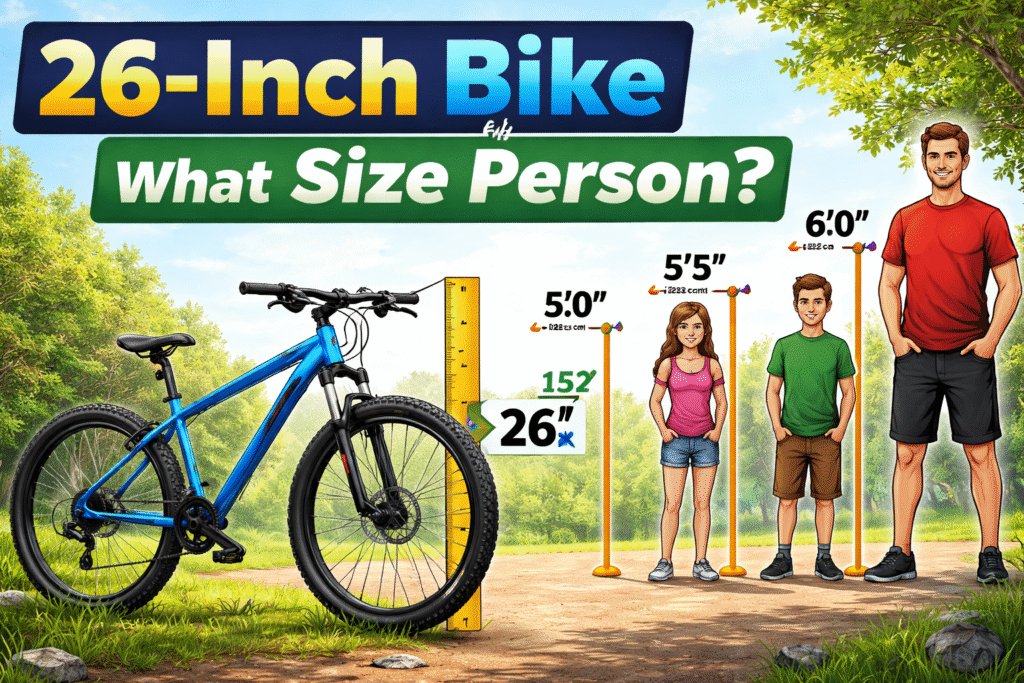
A common question many riders ask is: 26-inch bike for what size person? The answer depends on a combination of height, inseam length, and riding style, not just the wheel size alone.
Ideal Height Range for a 26-Inch Bike
In general, a 26-inch bike is best suited for riders who are approximately:
- 4 feet 10 inches to 5 feet 7 inches (147 cm to 170 cm)
This makes it a great choice for:
- Teenagers transitioning to adult bikes
- Short to average-height adults
- Beginners looking for easy handling and control
However, height alone isn’t everything—you also need to consider your body proportions.
What Type of Rider Should Choose a 26-Inch Bike?
A 26-inch bike is ideal for:
✅ Beginner riders – Easier to balance and control
✅ Casual cyclists – Perfect for city rides and light trails
✅ Shorter adults – Offers better comfort and reach
✅ Mountain biking beginners – Great for learning basic trail skills
- More agile and responsive
- Easier to maneuver in tight spaces
- Generally lighter and more affordable
Why Inseam Length Matters More Than Height
While height gives a general idea, your inseam measurement is key to finding the perfect fit.
👉 Ideal inseam for a 26-inch bike:
- Around 25 to 30 inches (63–76 cm)
Quick Tip to Measure Inseam:
- Stand straight against a wall
This helps ensure proper:
- Standover height (space between you and the frame)
- Comfortable pedaling
- Better control and safety
How Riding Style Affects Bike Size Choice
Your riding style also plays an important role:
- 🚵 Mountain Biking:
26-inch bikes are great for beginners because they offer better control on rough terrain. However, many modern riders also consider options from a mountain bike size chart by height or even upgrade to 27.5-inch wheels for smoother rolling. - 🚴 City & Commuting:
Ideal for short rides, errands, and urban cycling thanks to easy handling. - 🌄 Trail Riding:
Works well for light trails, but advanced riders may prefer larger wheels like those shown in a 27.5 mountain bike size chart.
Practical Tips to Choose the Right Fit
To make sure your 26-inch bike fits perfectly:
✔ Check a bike size for height adults guide before buying
✔ Ensure you can stand over the frame with slight clearance
✔ Adjust the seat so your leg is slightly bent at the bottom of the pedal
✔ Test ride the bike if possible
Beginner Comparison with Other Sizes
- 20-inch bike with training wheels: Best for kids learning to ride
- 24-inch bikes: Suitable for older kids or small teens (training wheels for 24 inch bike are sometimes available)
- 26-inch bikes: Ideal step into adult cycling
Mountain Bike Size Chart by Height
Choosing the right mountain bike size is essential for comfort, control, and performance. While wheel size matters, frame size is the most important factor when using a mountain bike size chart by height.
Mountain Bike Size Chart (Based on Rider Height)
| Rider Height | Frame Size | Frame Size (inches) | Typical Wheel Size |
|---|---|---|---|
| 4’10” – 5’2” (147–157 cm) | XS | 13–14” | 26” / 27.5” |
| 5’2” – 5’6” (157–168 cm) | S | 15–16” | 26” / 27.5” |
| 5’6” – 5’10” (168–178 cm) | M | 17–18” | 27.5” / 29” |
| 5’10” – 6’1” (178–185 cm) | L | 19–20” | 27.5” / 29” |
| 6’1” – 6’4” (185–193 cm) | XL | 21–22” | 29” |
Understanding Frame Sizes (XS, S, M, L)
XS (Extra Small)
- Best for riders under 5’2”
- Compact frame for better control
- Often paired with 26-inch wheels
S (Small)
- Ideal for riders between 5’2” and 5’6”
- Balanced comfort and maneuverability
- Commonly available in 26-inch and 27.5-inch bikes
M (Medium)
- Fits riders from 5’6” to 5’10”
- Most popular size for adults
- Usually comes with 27.5” or 29” wheels
L (Large)
- Designed for riders 5’10” and above
- Longer frame for better stability
- Typically uses larger wheel sizes (27.5” or 29”)
Where Do 26-Inch Bikes Fit in This Chart?
If you’re wondering again “26-inch bike for what size person”, here’s how it fits:
- Most common in XS and Small (S) frame sizes
- Ideal for riders between 4’10” and 5’7”
- Perfect for beginners and shorter adults
- Offers better control, lighter weight, and easy handling
Although newer bikes often use 27.5” or 29” wheels, 26-inch bikes are still a great option for:
- Entry-level riders
- Budget-friendly choices
- Tight trails and city riding
Quick Tips for Choosing the Right Size
✔ Always match your height with frame size first
✔ Use wheel size (26”, 27.5”, 29”) as a secondary factor
✔ Check inseam length for better accuracy
✔ When in doubt, choose the smaller size for better control
Beginner Tip
A properly sized bike will allow you to:
- Stand over the frame comfortably
- Reach the handlebars without stretching
- Pedal efficiently without strain
How to Choose a Mountain Bike Size (Step-by-Step Guide)
Picking the right mountain bike size may seem confusing at first, but if you follow these simple steps, you’ll find a bike that feels comfortable, safe, and easy to ride.
Step 1: Measure Your Height
Your height is the starting point for choosing the right bike size.
How to do it:
- Stand straight against a wall without shoes
- Use a measuring tape from the floor to the top of your head
👉 Once you know your height, you can compare it with a mountain bike size chart by height to find your frame size (XS, S, M, or L).
Step 2: Measure Your Inseam Length
Your inseam is even more important than your height when it comes to proper bike fit.
How to measure inseam:
- Stand with your back against a wall
👉 This helps you determine:
- Proper standover height
- Comfortable pedaling position
- Better overall control
Step 3: Check a Bike Size Chart
Now that you have your measurements, compare them with a reliable sizing chart.
Look for:
- Frame size (XS, S, M, L) based on height
- Wheel size recommendations (26”, 27.5”, 29”)
👉 For example:
- Shorter riders often fit 26-inch bikes
- Medium-height riders may prefer 27.5”
- Taller riders usually need 29” bikes
Step 4: Consider Your Riding Style
Your riding style can influence your bike size choice.
- 🚵 Trail riding: Choose a size that offers control and stability
- 🏙 City riding: Comfort and easy handling matter more
- ⛰ Rough terrain: Slightly smaller frames offer better maneuverability
👉 Beginners often feel more confident on slightly smaller bikes, such as a 26-inch model.
Step 5: Test Ride the Bike (If Possible)
Nothing beats trying the bike in real life.
When test riding:
- Check if you can easily reach the handlebars
- Ride a short distance to feel balance and control
👉 A good fit should feel natural—not stretched or cramped.
Step 6: Adjust the Bike for Perfect Fit
Even the right size bike needs small adjustments.
Key adjustments include:
- Handlebar position: Should feel relaxed, not too far forward
- Seat position: Adjust forward/backward for comfort
👉 Proper adjustments can greatly improve comfort and performance.
Step 7: Double-Check Before Buying
Before making your final decision:
✔ Reconfirm your measurements
✔ Compare different models and sizes
✔ Read manufacturer sizing guides
✔ Choose comfort over trends
Quick Beginner Tip
If you’re between two sizes:
👉 Choose the smaller size for better control and easier handling.
Can You Put Training Wheels on a 24-Inch Bike?
Yes, training wheels can be used on a 24-inch bike, but it’s not always straightforward. Compatibility depends on the bike’s design, and there are important safety factors to consider before installing them.
Compatibility of Training Wheels with 24-Inch Bikes
Most standard training wheels are designed for smaller bikes (12” to 20”), so fitting them on a 24-inch bike can be challenging.
What to Check:
- Axle Length: The rear axle must be long enough to support training wheels
- Frame Design: Some modern bikes don’t allow extra attachments
- Wheel Kit Size: You’ll need heavy-duty or adjustable training wheels specifically made for larger bikes
👉 In many cases, you may need specialized training wheels for 24-inch bikes, not standard ones.
Safety Considerations
Using training wheels on a larger bike comes with some risks, especially for older or heavier riders.
⚠️ Key Safety Points:
- Balance Limitation: Training wheels prevent learning proper balance
- Stability Issues: On uneven terrain, they can make the bike less stable
- Weight Support: Not all training wheels are strong enough for bigger riders
- Turning Risk: Sharp turns can feel awkward or unsafe
👉 Because of these factors, training wheels are less commonly recommended for 24-inch bikes.
When Is It Appropriate to Use Them?
Training wheels on a 24-inch bike may be useful in certain situations:
✅ Good Situations:
- Older kids or beginners who are just learning to ride
- Riders who feel nervous balancing on two wheels
- Temporary support before transitioning to independent riding
❌ Not Recommended For:
- Rough trails or mountain biking
- High-speed riding
- Long-term use
Better Alternatives to Training Wheels
Instead of training wheels, many experts recommend:
- Balance practice without pedals (like a balance bike method)
- Parental support while riding
- Riding on soft grass for safety
👉 These methods help riders learn balance faster and more naturally.
Final Tip
While it is possible to install training wheels on a 24-inch bike, they should be used only as a short-term learning tool. As soon as the rider gains confidence, it’s best to remove them and practice balancing independently.
Common Mistakes When Choosing Bike Size
However, many riders—especially beginners—make simple mistakes that lead to discomfort or poor riding experience.
1. Choosing Based Only on Wheel Size
One of the biggest mistakes is thinking that wheel size (like 26”, 27.5”, or 29”) determines the overall fit.
Why it’s wrong:
- Wheel size does not define how the bike fits your body
- Two bikes with the same wheel size can have completely different frame sizes
👉 Better approach: Always focus on frame size first, then consider wheel size as a secondary factor.
2. Ignoring Frame Size
Frame size (XS, S, M, L) is the most important measurement for proper fit.
Problem:
- A bike that’s too large can feel hard to control
- A bike that’s too small can feel cramped and uncomfortable
👉 Solution: Use a bike size for height adults guide or a mountain bike size chart by height to find the correct frame size.
3. Not Considering Riding Style
Different riding styles require different bike setups.
Example:
- Mountain biking needs more control and stability
- City riding focuses on comfort and ease
- Trail riding may require better maneuverability
👉 Tip: Choose a bike size that matches how and where you plan to ride.
4. Skipping Inseam Measurement
Many people rely only on height and ignore inseam length.
Why it matters:
- Inseam determines standover height and pedaling comfort
- Incorrect inseam fit can lead to poor control or injury
👉 Fix: Always measure your inseam for a more accurate fit.
5. Choosing the Wrong Size “Just in Case”
Some riders buy a bigger bike thinking they’ll “grow into it.”
Problem:
- Oversized bikes are harder to control
- Can lead to unsafe riding and discomfort
👉 Better choice: Pick a size that fits you right now, not in the future.
6. Not Test Riding the Bike
Buying a bike without trying it first is a common mistake.
What can go wrong:
- Uncomfortable reach to handlebars
- Poor balance or awkward riding position
👉 Solution: Always test ride if possible, even for a few minutes.
7. Ignoring Adjustments
Even a correctly sized bike needs proper setup.
Common oversight:
- Not adjusting saddle height
- Incorrect handlebar position
👉 Tip: Small adjustments can make a big difference in comfort and performance.
8. Overlooking Age and Skill Level
Choosing a bike without considering the rider’s experience can lead to issues.
Example:
- Beginners may struggle with larger bikes
- Kids may need proper sizing based on a bike size chart by age
👉 Tip: Match the bike size with the rider’s skill and confidence level.
Conclusion
Choosing the right bike size is essential for a comfortable, safe, and enjoyable riding experience. As discussed, factors like frame size, rider height, inseam length, and riding style all play a crucial role in finding the perfect fit. While wheel size—such as a 26-inch bike—can influence handling, it should never be the only factor in your decision.
A properly sized bike improves control, reduces the risk of injury, and makes every ride more efficient and enjoyable. On the other hand, the wrong size can lead to discomfort and poor performance.
Before making a purchase, always take the time to measure your height and inseam, compare your measurements with a reliable size chart, and test the bike if possible. A few extra minutes of preparation can ensure you choose a bike that fits you perfectly and enhances your overall cycling experience.
FAQs
Q1: Is a 26-inch bike suitable for adults?
Yes, a 26-inch bike is suitable for many adults, especially those of shorter to متوسط height. It’s commonly recommended for riders between 4’10” and 5’7” and is a great option for casual riding, commuting, and beginner mountain biking.
Q2: What height is best for a 26-inch bike?
The ideal height range for a 26-inch bike is typically 4 feet 10 inches to 5 feet 7 inches (147–170 cm). However, the best fit also depends on your inseam length and the bike’s frame size, so always check a size chart before buying.
Q3: Can a tall person ride a 26-inch bike?
Yes, a tall person can ride a 26-inch bike, but it may not be the most comfortable choice. Taller riders (above 5’10”) often benefit from larger wheel sizes like 27.5” or 29” for better stability and riding efficiency.
Q4: Is a 26-inch bike good for beginners?
Absolutely. A 26-inch bike is an excellent choice for beginners because it is easier to control, more responsive, and generally lighter than larger bikes. This makes learning to ride and handling the bike much simpler.
Q5: What is the difference between 26 and 27.5 bikes?
The main difference is the wheel size:
26-inch bikes: More agile, easier to handle, and better for beginners or shorter riders
27.5-inch bikes: Roll faster, handle obstacles more smoothly, and suit medium-height riders
Both have their advantages, so the best choice depends on your height, riding style, and experience